API Documentation
FastFlood API – Full Parameter Documentation
The FastFlood API allows users to run hydrodynamic flood simulations and related terrain-processing workflows by sending a single JSON payload to the API. A request describes the model domain, terrain data, hydrologic forcing, boundary conditions, and optional calibration or adaptation parameters. The API processes the request, runs the model, and returns links to generated output files such as flood depth, velocity, discharge, and terrain rasters.
The API follows a flexible design philosophy. Users can either rely on automatic setup options that configure most inputs automatically, or they can provide detailed manual inputs such as DEM files, rainfall rasters, boundary conditions, and surface parameters. Automatic options are typically the fastest way to run simulations, while manual inputs allow more control over the modelling process.
A typical request consists of a JSON object containing one or more parameter groups. The most important categories are domain definition, terrain input, hydrologic forcing, boundary conditions, surface properties, automation options, calibration settings, and observational data.
The self-documenting site is linked below
https://webapp-prod-fastflood.azurewebsites.net/docs#/model/run_model_v1_model_run_and_wait_post
And the latest documentation is available at
API Request inspection
You can obtain the actual API request used by FastFlood Global by looking at the Model Input Info from the website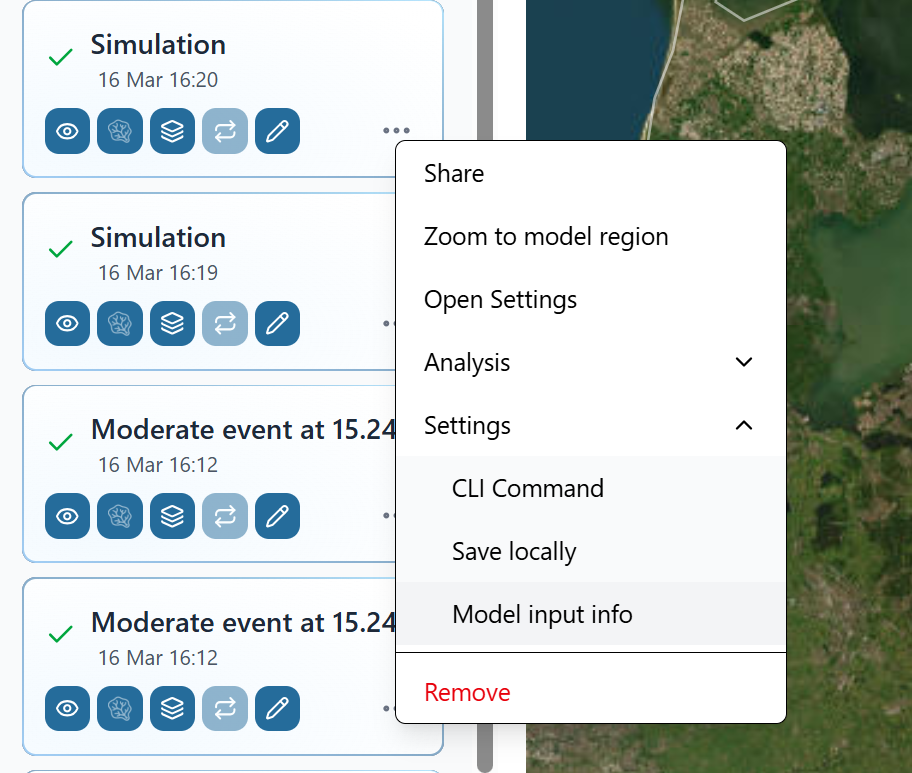
Note on Domain definition parameters
The simulation domain defines the geographic area for the model. The most common way to define the domain is using a bounding box.
bbox
Defines the spatial extent of the simulation. The bounding box must be given as an array of four coordinates in the following order:
[min_longitude, max_latitude, max_longitude, min_latitude]
This corresponds to west, north, east, and south boundaries of the domain. Coordinates must be in WGS84 latitude and longitude.
Example:
{
"bbox": [5.94, 52.21, 5.99, 52.18]
}